

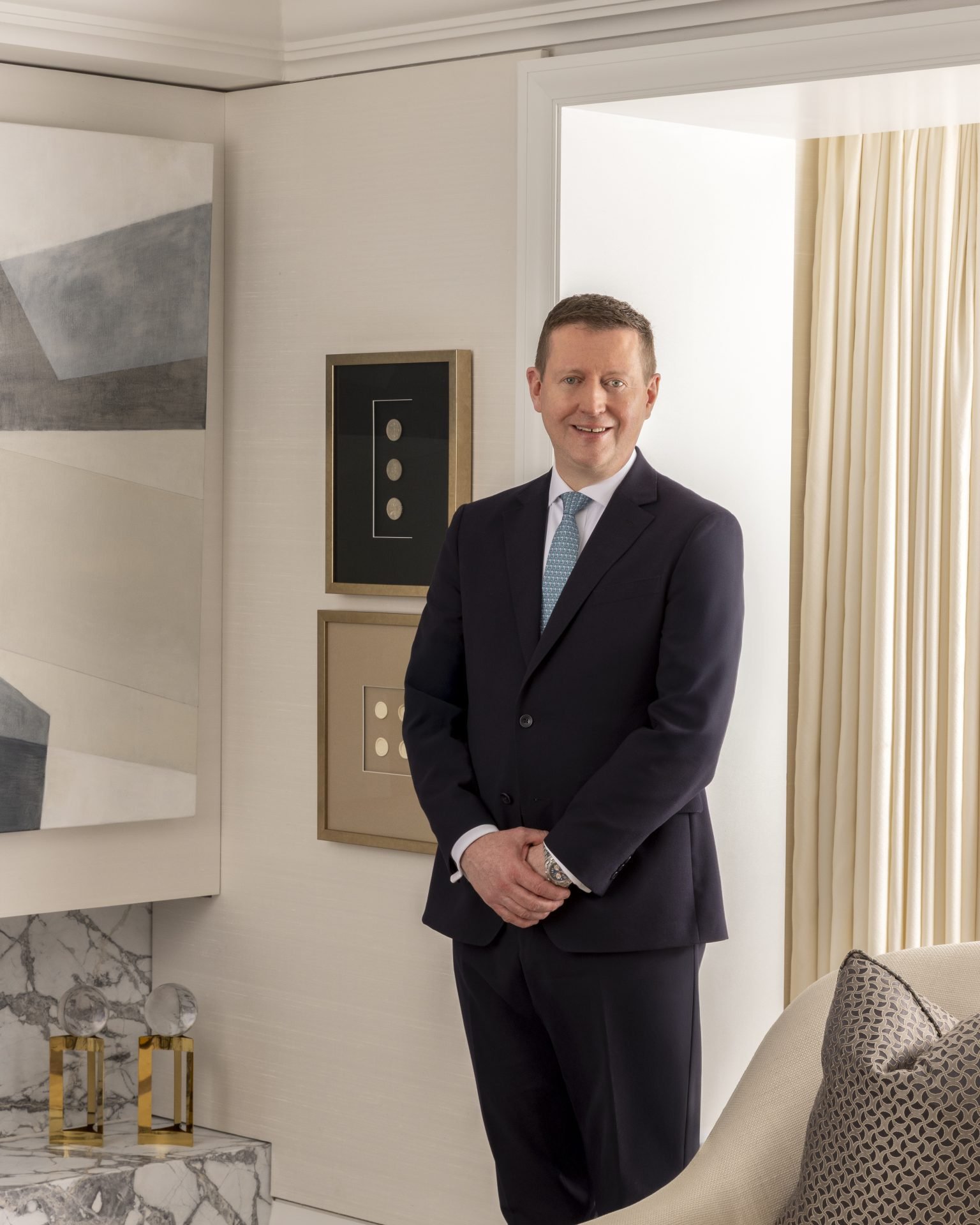
We spoke to James B. Clarke, General Manager at London Hilton on Park Lane to find out more about his views on modernising an iconic property, evolving guest expectations and why authenticity, adaptability and exceptional people will define the future of luxury hospitality.
 With flight disruptions, wildfires and geopolitical uncertainty affecting international travel, are you seeing a meaningful shift towards London staycations this summer? What are luxury hotel guests looking for when they choose to holiday closer to home?
Certainty has certainly become a genuine luxury in itself this year.
What is interesting is what guests are actually looking for when they do stay closer to home. Given the weather we have had this year, location and comfort have become the real draws. We are fortunate to sit right on Park Lane, moments from hotspots like Hyde Park, Green Park and Buckingham Palace – so guests get the feeling of a proper escape, with green space and skyline views, without ever really leaving London. It is that combination of a strong sense of place and comfort that is driving the staycation guest right now.
You’ve run luxury properties across the US, Caribbean and UK. What have those experiences taught you about how guest expectations differ from market to market and what do London guests expect that might surprise you?
The biggest lesson I have learned is that hospitality is never one-size-fits-all, even though the principle remains the same: people taking care of people. Alabama taught me the value of genuine warmth and connection, California the importance of relaxed yet professional service, and the Bahamas and Puerto Rico how local culture and team personality can shape the guest experience. New York, meanwhile, taught me pace, precision and anticipation – recognising what a guest needs before they have to ask.
London has brought all of those lessons together. I have learned to lead teams serving an international mix of guests while maintaining the character that makes a London hotel special. My biggest learning has been the importance of listening and adapting. Guests want recognition, authenticity and effortless service; while the fundamentals must be flawless, what they remember most is how you made them feel. With every guest wanting something different – from privacy to local knowledge or personalisation – the real luxury is having a team that can recognise those differences and adapt naturally.
You first joined London Hilton on Park Lane as Director of Operations a decade ago and have now returned as General Manager. What has changed most about the hotel, and how do you modernise an iconic property without losing the character and heritage that made it successful in the first place?
It has been a fascinating journey coming back to this hotel a decade on. So much has evolved; the multimillion-pound renovation completed in 2024 has transformed the guest experience, from the rooms and suites to our dining and drinking offerings. But what has not changed, and what I am most passionate about protecting, is the heritage.
This hotel has some extraordinary stories woven into its walls. The Beatles passed through the lobby on their way to meet Maharishi Mahesh Yogi. Princess Diana delivered one of her most defining public speeches in our ballroom. Keith Richards is said to have woken up here with the beginnings of the riff that became ‘Satisfaction.’ Those are not just anecdotes to me; they are part of the fabric of the building, and I see it as my job to make sure that history is never lost as we move forward.
Just as important are our people. Many of our team members have a deep connection to the hotel and are the custodians of its character, culture, and traditions. My ambition is to take that culture to the next level: empowering our team, creating opportunities for them to grow, and ensuring the warmth of our service evolves alongside the property’s physical transformation.
The reality is that the modern guest is changing, and we have to keep evolving to meet them, whether through our dining concepts, our suites, or the way we think about service. But modernising does not mean starting from scratch. It means finding ways to bring new energy to the hotel while staying true to what made it iconic in the first place. That balance, timeless heritage meeting the energy of now, is really at the heart of everything we do.
Following the hotel’s multimillion-pound renovation, what were the biggest opportunities and challenges in deciding what to change, what to preserve and what to completely rethink?
I have to be honest that I was not part of the hotel during the renovation itself, so I cannot take credit for those decisions, but I can say the team behind it had strong reasoning for every choice they made.
The ambition was to bring the hotel back to its glory days, but reimagined in a setting that feels entirely of today. And I think that is the real achievement of the renovation. That feeling you get walking in: iconic, glamorous, a real sense of occasion, has never been lost. If anything, it has been sharpened and brought into the modern day. That is a difficult balance to strike, because it would have been much easier to either preserve everything as it was or to strip it all out and start again. Instead, the team found a way to honour that original spirit while making the hotel feel completely current.
What does “luxury” mean to today’s hotel guests compared with when you first entered the industry more than 35 years ago? Are guests becoming more demanding, or are they simply looking for different things?
Luxury has changed enormously over the 35-plus years I have been in this industry, but I would not say guests have become more demanding – I would say they want more to show for what they are spending. With the cost of living continuing to rise, guests are far more discerning about where their money goes, and rightly so. A stay must earn its place.
It is just as much about the experience as it is about the day-to-day details—the people you meet, the warmth of the welcome from our team, the heart they bring to every interaction, and the small, thoughtful touches in the room that make you feel genuinely looked after.
When I started out, luxury was often measured in marble and chandeliers. Today, it is measured by whether a guest feels that every touchpoint of their stay, however small, was considered with them in mind. That is a much higher bar, in some ways, than simply providing opulence.
You’ve served as Chair of the Master Innholders. What do you think distinguishes an exceptional hotel leader today, particularly at a time when the industry is dealing with changing guest expectations, recruitment challenges and rising costs?
For me, that is exactly what defines an exceptional leader today: anticipating that guest expectations, spending patterns, and challenges will shift, rather than waiting to react once they have. The industry is dealing with recruitment pressures, rising costs, and a guest who is rethinking how they spend, and the leaders who do well are those who identify these shifts early and address them head-on, rather than being caught off guard by them.
But leadership also starts with taking care of people. We have to look after our team, play a meaningful role in our community and, in turn, enable our team to take exceptional care of our guests. There is a great saying that culture eats strategy for breakfast, and I believe that. You can have the strongest strategy in the world, but if the culture is not right, people, and ultimately our guests, will feel it. Hospitality has to be sincere. When people know they are valued, that sincerity comes through in every interaction.
We know that people still want to travel – they are just being more thoughtful about how they do it. Whether that is the type of trip, the length of stay, or what they prioritise once they are there, guests are making more considered choices. My job, and I would say the job of any hotel leader right now, is to read those changes and make sure the experience we deliver is the best it can possibly be, whatever form that travel takes.
Looking ahead, what do you think will define the next era of luxury hospitality in London, and what role do you want London Hilton on Park Lane to play in it?
I think the next era of luxury hospitality in London will be defined by authenticity over spectacle. Guests now have access to beautifully designed hotels all over the world, so the differentiator is not who has the newest marble or the flashiest lobby; it is who can offer a genuine sense of place, real heritage, and an experience that actually means something. London has an advantage: a depth of history and culture that cannot be replicated or fast-tracked.
I would also say the next era will be shaped by flexibility: in who we welcome and how. We have seen this summer just how quickly travel patterns can shift, whether guests choose to stay closer to home or long-haul visitors rethink their plans. Hotels that thrive will be the ones built on breadth rather than reliance on any single guest segment or market, and that can flex with confidence as the world around them changes.
As for London Hilton on Park Lane, I want us to be a hotel that proves heritage and modernity are not in tension with each other. We have more than 60 years of stories in these walls, an address that is genuinely part of London’s fabric, and now a renovation that has brought all of that into the present day. My ambition is for this hotel to keep setting the standard for what it means to be an iconic London address – somewhere that feels unmistakably of this city, whilst never standing still.
But none of this happens without our team members and everything they do. I often say that if we can make a guest feel as though they are floating on a magic carpet, they will always want to come back. What they may not see is the extraordinary care, teamwork, and attention to detail behind that experience, and that is the real magic of hospitality.