

Only 6% of available hotels with parking across the UK offer EV charging to customers, according to new research from Drax Electric Vehicles.
Smaller cities are leading in EV charger availability at hotels, as St David’s ranks number one.
EV charging experts advise that hospitality businesses must invest now to build a strong reputation and market competitiveness for the future.
New research finds that only 6% of city hotels offer customers access to chargers, revealing the top UK cities with hotels offering EV charging facilities.
Analysing over 15,000 hotels across 74 UK cities, Drax Electric Vehicles has uncovered a wide disparity in EV charging availability, with major cities failing to provide suitable charging infrastructure at their hotels.
St Davids in Wales ranked top for EV-friendly hotels, with over one in five (22%) providing EV charging facilities. It was followed by Milton Keynes (16%), Central London (15%) and St Albans (12%).
Commenting on the findings, Adam Hall, Director at Drax Electric Vehicles, says: “We are seeing a record number of electric vehicles on our roads, with zero-emission vehicles accounting for 2.7 per cent of all cars in use in 2023. While uptake is often higher in major metropolitan cities like London, where policies such as the ULEZ incentivise EV ownership, our research shows a need for further development in charging infrastructure across many hotels.”
“If hospitality businesses want to keep pace with the rapidly growing EV market, they must invest now to build a reputation for offering good EV charging facilities.”

How do hotels across UK major cities compare?
Despite having the largest number of hotels available with parking, major cities like Birmingham, Manchester, and York still need to catch up in the proportion of hotels offering charging facilities compared to smaller cities. Only 1 in 25 (4%) Birmingham hotels offer this amenity.
Comparing the major cities’ development, Central London is making good progress, with 1 in 6 hotels with parking equipped for EVs. York (8%), Bristol (6%), Edinburgh (6%), and Manchester (6%) followed.
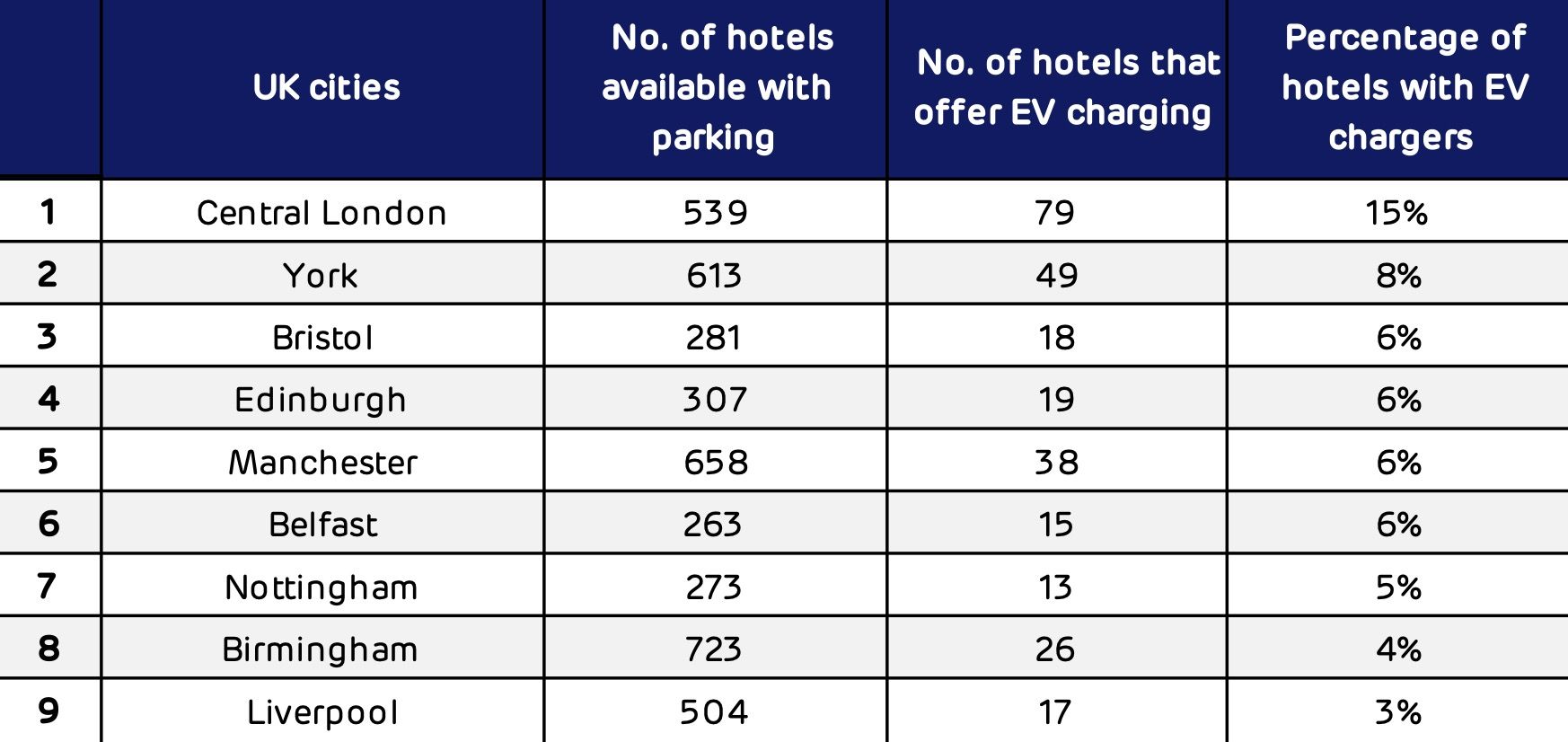
The data reveals a need for big cities to invest further in EV charging infrastructure. Hotels which invest in EV chargers are in an advantageous position, staying ahead of potential government requirements and avoiding future retrofit costs and disruptions.
Adam continues, “Investing in EV charging will quickly give these businesses a competitive advantage, attracting potential new customers and better serving their existing ones when they eventually make the switch. Hospitality venues provide the perfect location for EV drivers to top up when they’re not at home, as they already have a purpose and incentive for visiting.”
“Along with the customer benefits, EV charging also allows businesses to encourage customers to spend more during their visit, as drivers are likely to spend longer there to get more charge. This could be the difference between them grabbing an extra coffee and making an additional purchase decision. When combined with any profits made for charging, it’s easy to see the return on investment.”
Hotels with EV chargers also contribute to the electric vehicle supply equipment (EVSE) grid, offering the public more accessibility to charging points and promoting sustainability.
Naomi Nye, EV charging specialist at Drax Electric Vehicles, explains: “As EV adoption grows, hotels must focus on becoming more EV-friendly. Offering EV chargers is no longer a premium experience but a necessity. These findings underline the growing importance of EV infrastructure in the hospitality industry to support the UK’s net-zero ambitions. This is a key area for growth and investment to attract more eco-conscious travellers.”