

Hotel design in 2026 has moved on from filling every wall with a matching set of small frames. The new instinct among interior teams is simpler: pick one large, deliberate piece and let it do the talking.

Guests form a first impression of a space within roughly seven seconds of entering, according to industry research cited by hotel design firm Mingsun Group. That’s not enough time to notice a gallery wall of eight small prints. It’s enough time to register one bold, well-placed canvas. Hoteliers who understand this are rethinking how they use their walls, and the shift shows up first in the lobby, then spreads through corridors and guest rooms.
Large-Format Art as the New Lobby Focal Point
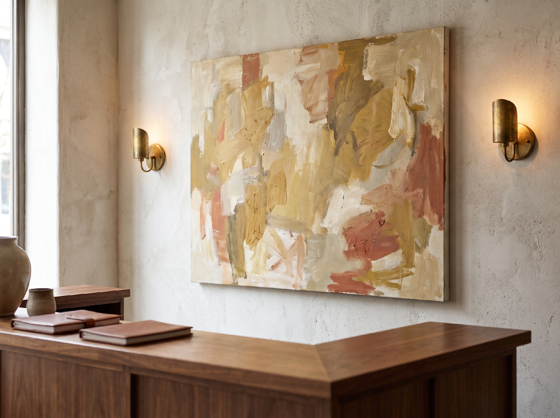
The “lobby as gallery” concept isn’t new to design magazines, but it’s becoming a practical brief that owners hand to their interior teams. Rather than treating the reception wall as leftover space, designers now build the whole entrance sequence around a single piece large enough to hold its own against a double-height ceiling or a long reception run.
That seven-second window matters commercially. A guest walking through revolving doors after a delayed flight doesn’t read a brand mission statement on a plaque. They read the room. An oversized horizontal piece behind the desk, or running the length of a seating bank, communicates identity instantly, before a single word is exchanged at check-in.
This is also a sourcing problem, and it is a narrower one than most designers expect. Standard framed prints top out well before the width a long reception wall actually needs, which pushes hoteliers toward specialist collections built for exactly that scale. Hoteliers refreshing a lobby wall increasingly turn to pieces like the extra large horizontal wall art collection, produced specifically for wide architectural spaces above reception desks or along long seating runs, rather than stretching a standard print past its intended proportions.
From Lobby to Guest Room: Scaling the Statement Piece
The same logic that works in a lobby carries into guest rooms, though the goals shift slightly. A lobby piece has to announce a brand fast. A guest room piece has to calm someone down after a day of travel.
That calming brief sits inside a broader 2026 trend some designers call “restorative luxury”: rooms engineered around rest as much as aesthetics. A single wide artwork above the headboard, in place of two smaller mismatched frames, gives the eye one point to settle on rather than several competing ones. It’s a small change, but it removes visual noise from a space that is meant to reduce noise, not add to it.
Sound plays into this too. The World Health Organization’s environmental noise guidelines recommend average night-time noise exposure outside dwellings stay below 40 dB(A) to protect sleep quality, part of the same “invisible architecture” thinking now shaping acoustics, lighting, and materials in guest rooms. A room’s visual calm and its acoustic calm are increasingly designed together rather than as separate line items on a renovation budget.
Studios doing this well are getting recognised for it too; we covered several of these approaches in our feature on the UK’s leading hospitality interior designers, where headboard art and acoustic treatment show up as a single design conversation rather than two.
The Business Case: Design as Revenue Driver, Not Just Decoration
Design decisions like this aren’t just aesthetic preferences anymore. They show up on the balance sheet, a link that Cornell’s Center for Hospitality Research has documented across years of academic studies on guest experience and property performance.
Properties that embed authentic local culture through commissioned local-artist installations, regional material sourcing, and neighbourhood storytelling design achieve 26% higher average daily rate than comparable cookie-cutter competitors, according to the 2025 Boutique Hotel Performance Index. Multi-functional lobbies that double as co-working spaces, cafés, or informal galleries generate 42% more non-room revenue than traditional check-in-counter layouts, per PKF Hospitality Research’s 2025 data. A striking piece of art isn’t the whole reason for those numbers, but it’s very often the visual anchor that makes a hybrid lobby feel intentional rather than improvised.
The American Hotel & Lodging Association’s 2025 State of the Industry Report, produced with Accenture, confirms rising guest demand for unique, experience-driven stays even as operating costs, including design and maintenance, rose nearly 5% in 2024. That combination puts pressure on owners: guests want more distinctive spaces while budgets get tighter. One well-chosen large-format piece is, in that context, a comparatively efficient way to deliver a memorable first impression without a full renovation.
The Derby London City’s conversion from office building to Curio Collection by Hilton hotel is a good example of how a design-led repositioning project can transform guest perception of a property, art included, without touching the building’s core structure.
Sourcing Art That Works at Hotel Scale
Buying art for a hotel is a different exercise to buying art for a home, and treating it the same way is where a lot of projects go wrong.
Durability comes first. High-traffic lobbies, direct sunlight through glazed entrances, and daily contact from housekeeping staff all take a toll on canvas and framing that a private collector never has to think about. Commercial-grade materials and mounting hardware rated for public spaces matter more than the piece’s price tag.
Scale and proportion come second. A piece that reads well on a gallery wall can look lost above a 12-foot reception desk, or overwhelming above a standard headboard. Measuring the actual wall run before selecting a piece, rather than choosing a piece and hoping it fits, avoids a costly reorder.
Brand alignment matters just as much as either of those. The palette, subject matter, and tone of a lobby’s central artwork should match the property’s identity the way its lighting and furniture already do. And where budget allows, working with regional or local artists on a commissioned piece supports the “authenticity” trend that is already showing up in the ADR data above. Coterie, the Portuguese boutique hotel brand built almost entirely around aesthetic detail, demonstrates how far a property can push this idea when art and interior design are planned together from the start rather than bolted on at the end.
Getting the Balance Right
None of this means every hotel needs a single enormous canvas and nothing else. Smaller accent pieces still have a place in corridors, breakfast rooms, and quieter corners. What has changed is the hierarchy: the days of a dozen equally sized frames competing for attention are giving way to one confident anchor piece supported by smaller, quieter details around it.
For owners weighing a refurbishment budget this year, the art line item deserves more scrutiny than it usually gets. A well-placed large-format piece isn’t just decoration. It’s doing measurable work on first impressions, guest comfort, and, if the data above holds, on revenue too.